For many in higher education and the recovery community, 2025 was a year marked by uncertainty, loss, and profound change. Across the country and beyond, we witnessed programs lose funding, positions go unfilled, and students face shrinking access to the support services they rely on. These challenges were not abstract – they were personal, deeply felt, and often exhausting. And yet, alongside this grief and disruption, we also saw something enduring: people showing up for one another, refusing to let recovery disappear from campuses, and continuing to believe in education as a powerful pathway to healing and possibility
Throughout the year, ARHE worked to meet this moment by staying grounded in our mission while remaining responsive to the evolving needs of students, professionals, families, and institutions. Through training, technical assistance, research, advocacy, convenings, and community-building efforts, we focused on strengthening the infrastructure that allows collegiate recovery to survive – and grow – even in difficult conditions. In particular, 2025 marked a significant expansion of ARHE’s role as a national backbone organization for collegiate recovery, with technical assistance serving as a critical mechanism for stabilizing programs, translating research into practice, and supporting systems-level change. From launching new tools and resources, to supporting institutions at every stage of development, to gathering in shared spaces for learning and connection, our work was shaped by both urgency and care.
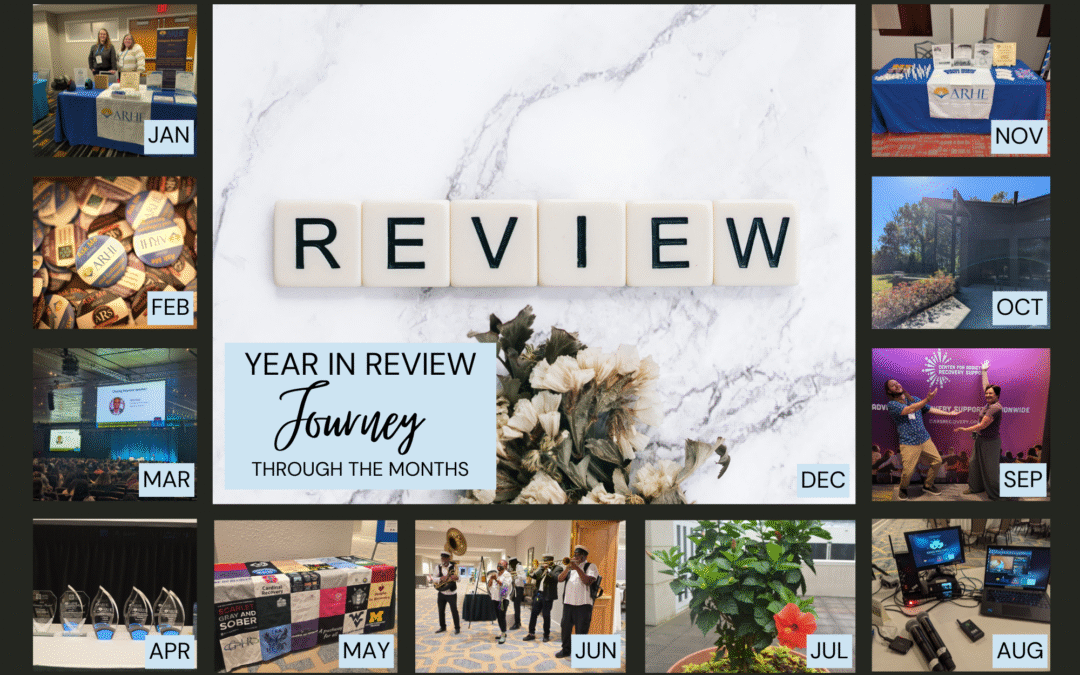
This Year in Review is not just a list of accomplishments. It is a reflection of collective resilience, collaboration, and commitment across the collegiate recovery ecosystem. Each milestone below represents countless conversations, partnerships, late nights, and shared hope. As we look back on 2025, we do so with gratitude for everyone who contributed their time, trust, and energy – and with renewed resolve to continue building recovery-supportive campuses where students can truly thrive.
January
- ARHE launched our new online membership portal to improve member experience and engagement and consolidate benefits. ARHE also launched automated membership renewal emails to improve communication and better support member institutions in maintaining consistent access to member benefits.
- ARHE also re-launched a new Resource Hub for members to access.
- ARHE also launched a descriptive database of Collegiate Recovery research.
- The Center for Addiction Recovery Support (CARS) officially launched, offering Technical Assistance and Training (TTA) under SAMHSA. ARHE is a national partner organization of CARS, providing technical assistance support for collegiate recovery.
- ARHE played a central role in shaping collegiate recovery–specific technical assistance protocols under CARS, including intake, triage, documentation, and field-informed TA delivery models.
- ARHE exhibited at the NASPA Strategies conference in Boston, MA, with support from CARS.
- Completed edits on a guidebook for SAMHSA on how state entities can advocate for collegiate recovery and recovery high schools (awaiting publication).
- ARHE staff received new positions and titles.
- ARHE Board of Directors nominations were opened to fill vacant positions.
- The ARHE/ARS/AAPG conference call for proposals closed at the end of the month.
- Programming Sessions:
- Membership Portal Overview, Training and Feedback Listening Session – Facilitated by Mack Park
- Access, Belonging and Connection Book Club: Saving Our Own Lives (session 4) – Facilitated by Ayesha Al-Akhdar
February
- ARHE partnered with Indivior to support a student-led focus group on opioid overdose awareness on campuses.
- ARHE released a toolkit for “Hosting a Collegiate Recovery Day at Your State Capitol,” with an addendum including some considerations for schools internationally in Canada and the UK.
- Programming Sessions:
- Mindfulness and Meditation: How These Practices Can Be Helpful to Practitioners and Students – Facilitated by Katherine Drotos Cuthbert
- Remember You Are Not Alone: Working With Young Adults Living with Parents Who Use Alcohol/Drugs – Facilitated by Edith Hornik-Beer
- Collegiate Recovery in Community Colleges – Facilitated by Aaron Blankenship
- Alternative Peer Groups: What Are They and How Do They Work? – Facilitated by J. Michael Wilkerson and Robin Bergeron
- Discoveries in Recovery: How Are Therapy Can Support People With Substance Use Disorders – Facilitated by Rachelle Ellis
- What is Collegiate Recovery and Why Is It Important? (Collegiate Recovery 101) – Facilitated by Kristina Canfield
- Listening Session: How to Demonstrate Support for Students While Having Confidence in One’s Own Ability? – Facilitated by Kristina Canfield, Bret Frazier, and Mack Park
- Access, Belonging and Connection Book Club: Saving Our Own Lives (session 5) – Facilitated by Ayesha Al-Akhdar
March
- ARHE attended, tabled, and presented at the Southern College Health Association (SCHA) conference in Athens, GA, with support from CARS.
- ARHE exhibited at the Southeastern Louisiana Recovery Capital Conference while also helping co-facilitate a one-day workshop for institutions across the state of Louisiana who are in early stages of building their collegiate recovery programs as part of a state-wide expansion.
- ARHE exhibited at NASPA Annual in New Orleans, LA, with support from CARS.
- ARHE also did a walkthrough of our conference hotel location in New Orleans – in preparation for our event!
- ARHE launched biweekly support meetings for Collegiate Recovery Professionals in an all-recovery style.
- Programming Sessions:
- Collaborating with Campus Partners – Facilitated by Lindsay Garcia
- Community Colleges: Leveraging a CRP to Create a College-to-Workforce Pathway and Gain Institutional Buy-in – Facilitated by Eric Klein
- Arts Based Programming in Collegiate Recovery – Facilitated by Rachelle Ellis and Ayesha Al-Akhdar
- Mapping Change: Using Environmental Scans and Storytelling to Transform Substance Use Prevention and Recovery – Facilitated by Santee Ezell
- The Interweaving of Sexual Violence and Substance Use – Facilitated by Lex Johnson
- Breaking Down the Getting Started Guide: Early Planning – Considerations and Readiness – Facilitated by Bret Frazier and Mack Park
- Listening Session: How Can Collegiate Recovery Programs and Recovery Community Organizations Best Collaborate? – Facilitated by Bret Frazier, and Mack Park
- Access, Belonging and Connection Book Club: Saving Our Own Lives (session 6) – Facilitated by Ayesha Al-Akhdar
April
- ARHE hosted the 15th annual Collegiate Recovery Week celebration.
- The week’s theme was “15 Years of Growth, Rooted in Support, Branching into the Future.” Daily sub-themes included “Celebrating Our Roots,” “Celebrating the Forest Through the Trees,” “Cultivating Community and Strengthening Our Cores,” “Nurturing the Soil and Planting New Seeds,” and “Branching Into the Future and Reaching New Heights.”
- People all over the world wore purple on April 15th to counter stigma and support collegiate recovery! Several of those people wore limited edition collegiate recovery week swag to commemorate this 15-year milestone, which was available for purchase on our website leading up the event!
- ARHE continued to collect squares for the Collegiate Recovery Quilt – which was then showcased for the first time at the conference in June!
- ARHE hosted a town hall meeting, alongside six webinars throughout the week, each on a variety of topics to celebrate the history, present, and future of collegiate recovery.
- Member institutions hosted numerous events throughout the entire week, both virtually and in person. Those who shared flyers and were open to others to attend were posted to the ARHE website to create a jam-packed calendar week for anyone looking to participate in the festivities.
- ARHE launched a special edition social media toolkit with 82 downloadable graphics with post copy and alt-text to copy/paste, alongside custom cover photos, zoom backgrounds, stickers, hashtags, banners, and printable signs.
- Incoming Board Members were announced and outgoing Board Members celebrated.
- 2025 ARHE, ARS, and AAPG Award Winners were announced, to be celebrated at the awards ceremony in June.
- ARHE raised money for a scholarship fund to help support the travel of staff and students to attend the annual conference.
- ARHE released its 2024 Impact Report, providing an overview of the past year.
- ARHE released an email template, follow-up email template, and phone script to support people contacting their legislators to advocate for Collegiate Recovery. ARHE’s Executive Director released a recorded video about the importance of advocating and provided a one-pager with Key Advocacy Points to Communicate.
- ARHE launched its Biennial Survey of Collegiate Recovery Programs to continue collecting longitudinal data about existing programs and inform future efforts.
- ARHE released the updated Getting Started Guide, in collaboration with the Center for Addiction Recovery Support (CARS), funded by the Substance Abuse and Mental Health Services Administration (SAMHSA). The update includes a new addendum to address the unique needs of community colleges and technical schools.
- The updated guide quickly became one of the most frequently referenced tools in ARHE’s technical assistance work, particularly for community colleges, early-stage programs, and state-funded expansion efforts.
- ARHE staff attended the 2025 National Conference on Addiction Recovery Science (virtual conference).
- ARHE re-structured its member regional map. The former “Mountain” region became part of the “West” and “Midwest” regions to better support the participating programs and share resources. Additionally, ARHE introduced a new International Region Representative on the Board of Directors to ensure that Trans-Atlantic programs are represented and supported at the board level.
- Louise Irizarry was hired full time with ARHE.
- Programming Sessions:
- Men’s Mental Health & Peer Support: A Conversation with Mike and Chris – Facilitated by Mike Dorochan and Chris Melendez
- Transitioning CRP Policy and Procedure: How Do We Serve Students Who Do Not Practice Abstinence? – Facilitated by Ayesha Al-Akhdar
- Students Spearheading Campus Harm Reduction: A Panel Discussion – Facilitated by SAFE Project, Sydney Cheifetz, Amanda Fowler, Mahish Rajdev, John Simpson, and Sarah Smith
- Collegiate Recovery Week Kickoff Meeting & Town Hall – Facilitated by Kristina Canfield, Mack Park, and Bret Frazier
- Roots and Branches: A History of Collegiate Recovery – Facilitated by Andy Finch
- Key Insights From Our Study on Collegiate Recovery: What We’ve Learned So Far – Facilitated by Noel Vest
- Power of Authentic Connections (Interactive Session) – Facilitated by Jason Parete
- How We Think About Substance Use Matters: A Paradigms Exercise – Facilitated by Dylan Dunn (SAFE Project)
- Empower Hour: Student-led Advocacy, Action, and Communication with Legislators – Facilitated by Christina Reardon-Harrah and Tammy Bradford
- Chronic Illness & Accessibility in Higher Education Mental Health and Substance Use Disorder – Facilitated by Ann Fink
- Show Me the Money: Unlocking Private, Public, and Opioid Settlement Funding for Collegiate Recovery – Facilitated by Kristen Harper
- From Student to Staff Within Collegiate Recovery – Facilitated by Bryan Sadler
- Breaking Down the Getting Started Guide: Important Milestones – Facilitated by Bret Frazier and Mack Park
- Listening Session: What Does a Recovery Friendly Campus Look Like to You? – Facilitated by Kristina Canfield and Mack Park
- Access, Belonging and Connection Book Club: Saving Our Own Lives (session 7) – Facilitated by Ayesha Al-Akhdar
May
- ARHE began a comprehensive, state-funded collegiate recovery expansion initiative with the Rhode Island Department of Behavioral Healthcare, Developmental Disabilities & Hospitals (BHDDH). This work included onboarding multiple institutions, delivering customized technical assistance, developing shared tools and resources, and supporting statewide coordination and sustainability planning. This initiative served as a model for how state agencies can partner with ARHE to build recovery-supportive infrastructure across public and private institutions.
- ARHE attended, tabled, and presented at the Southeastern Collegiate Recovery Community Summit, with support from CARS.
- Programming Sessions:
- Family & Alumni in CRPS – Facilitated by Kelly Miller
- Be a Lightning Rod: Recovery Advocacy – Facilitated by Neil Campbell
- Collegiate Recovery Advocacy & ARHE Call to Action – Facilitated by Kristina Canfield
- Access, Belonging and Connection Book Club: Saving Our Own Lives (session 8) – Facilitated by Ayesha Al-Akhdar
June
- ARHE attended the Faces and Voices of Recovery (FaVoR) Recovery Leadership Summit in Washington, DC.
- ARHE completed the first official SRCRA review after the completion of the accreditation pilot: Tulane University became the first Fully Reviewed collegiate recovery program in Louisiana.
- ARHE welcomed new Board of Directors members at the annual Board Retreat.
- ARHE, ARS, and AAPG hosted our annual conference in New Orleans, LA. This was our second-ever hotel conference, and we were excited to be back in the Southeast. An overview by the numbers:
- 4.5 Days
- 514 Attendees
- 185 Speakers
- 118 Sessions
- 14 Posters
- Up to 21.5 CE Units
- 17 Award Winners
- > 100 Hours of Recorded Content
- 10 Onsite Recovery Meetings
- 1 Concert
- 1 Movie Screening
- 9 Wellness Activities
- 2 Networking Events (with food!)
- 4 Meals Provided
- 7 Coffee Breaks Provided
- 3 Conferences in One
- 5 Countries Represented
- A Wellness Room, Relaxation & Quiet Lounge, and Nursing Room available all day
- Programming Sessions:
- Moving From “Enabling” to Recovery Allyship – Facilitated by Jill Farnsworth
- Conference Volunteer Orientation / Training – Facilitated by Bret Frazier, Kristina Canfield, and Mack Park
July
- ARHE staff spent dedicated time improving our Salesforce back-office system, and in many cases, scanning printed records to digital files. This was significant because as our field continues to grow, we need to make sure that ARHE has the infrastructure to grow with it – plus, we want to save the trees!
August
- ARHE attended & presented at the Oxford House World Convention in Oxon Hill, MD.
- In partnership with the Opioid Response Network (ORN), Executive Director Kristina Canfield presented multiple workshops about collegiate recovery and substance use prevention at Delta State University and Tuskegee University.
- ARHE’s Executive Director, Kristina Canfield, presented a keynote session at the 2025 VitAL Conference in Tuscaloosa, AL as part of ARHE’s work with the ORN.
September
- ARHE attended the Center for Addiction Recovery Support (CARS)’s National Convening in Atlanta, GA, with support from CARS.
- ARHE released collegiate recovery-specific graphics to share out during Recovery Month and increase visibility of recovery on campuses.
- ARHE supported the Mobilize Recovery Campus Surge events that happened across the nation in celebration of recovery month.
- Photos were publicly released from the ARHE/ARS/AAPG annual conference and session recordings were added to the ARHE Resource Hub.
- Programming Sessions:
- Access, Belonging and Connection Book Club: Trauma and the 12 Steps (session 1) – Facilitated by Ayesha Al-Akhdar
- Trauma Informed Language and Approaches 101 – Facilitated by Lex Johnson
- Making the Case for Collegiate Recovery: Leveraging the Okanagan Charter to Advance Student Well-being
October
- ARHE attended and supported the Collegiate Recovery Research Collaborative summit in Richmond, VA, with support from VCU and CARS.
- ARHE exhibited at the HECAOD National Meeting in Columbus, OH, with support from CARS.
- ARHE began the accreditation process with all of the IBX-funded institutions across southwestern Pennsylvania, to be completed through Q1 of 2026.
- ARHE’s Executive Director, Kristina Canfield, was the keynote speaker at the Judeo-Christian Outreach Center (JCOC)’s Black & White Gala, celebrating JCOC’s 39th anniversary and shining a light on homelessness, hunger, and the power of recovery.
- In partnership with the Opioid Response Network (ORN), Executive Director Kristina Canfield presented multiple workshops about collegiate recovery and substance use prevention at the Mississippi Student Nurses Association Annual Conference.
- Programming Sessions:
- Access, Belonging and Connection Book Club: Trauma and the 12 Steps (session 2) – Facilitated by Ayesha Al-Akhdar
- Access, Belonging and Connection Retrospective – Facilitated by Ayesha Al-Akhdar
- ARHE Membership Meeting – Facilitated by Kristina Canfield
- From Concept to Catalyst: Building Advisory Boards – Facilitated by Blake Schneider
November
- ARHE attended the Higher Education Quality Council of Ontario’s annual conference in Toronto, ON, with their support.
- ARHE launched its Giving Tuesday campaign with the ability for every donor to choose what was most important to them: supporting students, training the workforce, helping families and high school graduates transition to college, building the national movement, or supporting ARHE where it’s needed most.
- Programming Sessions:
- Making the Most of What We Have: Frameworks for Maximizing Campus Overdose Prevention Efforts – Facilitated by Dylann Dunn (SAFE Project)
- ARHE Membership Meeting – Facilitated by Kristina Canfield
- Rolling the Dice on Our Future: Addressing America’s Youth Gambling Crisis – Facilitated by Saul Malek
December
- Programming Sessions:
- Access, Belonging and Connection Book Club: Trauma and the 12 Steps (session 3) – Facilitated by Ayesha Al-Akhdar
- Understanding Kratom: What Higher Education Professionals Need to Know Now – Facilitated by Jana Wu (Mountainside Treatment Center)
- ARHE Membership Meeting – Facilitated by Kristina Canfield
Throughout the year, ARHE continued to provide Technical Assistance and Training through the Center for Addiction Recovery Support (CARS), funded by the Substance Abuse and Mental Health Services Administration (SAMHSA). Some key highlights from TA include:
- 78 TA requests via CARS throughout the first year of the project, 48 of which were from campuses or entities that had never interacted with ARHE prior.
- Engaged with campuses across 21 states and across all ARHE Regions.
- The development and implementation of a full-day, onsite, intensive training at the University of Alabama Birmingham, that included key administrators on campus.
- Publication of a Regional Needs Assessment of the ARHE Regions to better understand the key needs and trends in each region.
- Common themes identified where structured data existed included:
- Program development and start-up
- Funding strategies and sustainability planning
- Overdose prevention policy and naloxone distribution
- Student engagement and retention
- Staff training and supervision
- In addition to quantitative growth, ARHE’s technical assistance work in 2025 increasingly supported complex, systems-level needs, including recovery housing exploration, ethical decision-making around non-abstinence and return-to-use, workforce role clarification, ADA and accommodations advocacy, and state-level funding alignment. Many TA engagements extended beyond single institutions to include multi-campus systems, state agencies, and cross-sector partnerships.
Across all areas of work, ARHE continued to prioritize relational, values-driven engagement – meeting campuses where they are, honoring recovery’s many pathways, and supporting both innovation and accountability in a rapidly evolving field. As we close out this reflection on 2025, we are reminded that the work of collegiate recovery is never done in isolation – it is sustained through relationships, shared learning, and a deep commitment to showing up for students where they are. The technical assistance, training, and support highlighted throughout this year reflect not only ARHE’s efforts, but the collective wisdom, honesty, and persistence of the many campuses, professionals, students, and partners who engaged with us along the way. We are profoundly grateful for your trust, collaboration, and courage during a year that asked much of us all. As we move into the year ahead, we remain committed to listening closely, adapting thoughtfully, and continuing to build recovery-supportive environments in higher education – together.